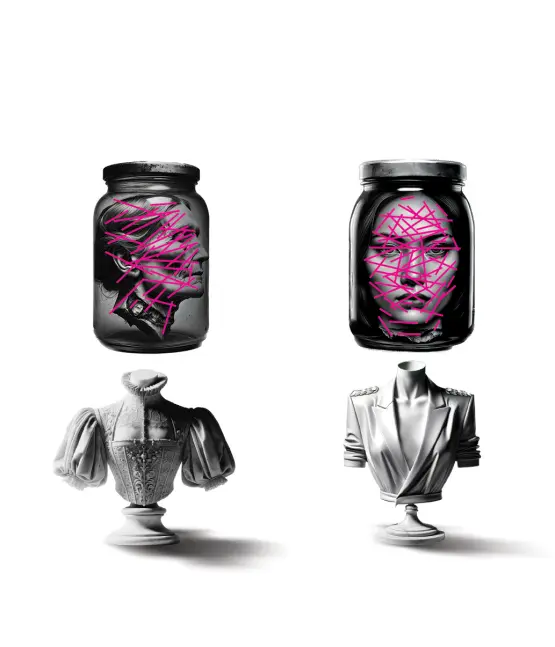
Inspired by an Object's History
ENTERTAINMENT IN PUBLIC
Interdisciplinary Archival Project
by Taha Zaker
Curated by Hoda Sargordan
Project description
While the archival materials used in this installation construct a narrative of microhistory. The project challenges dominant historical narratives by exposing their absences and contradictions. As an interdisciplinary art project Entertainment in Public explores the history of execution and the transformation of public execution into modern spectacle. Presenting this project today is inseparable from the continuing reality of the death penalty and contemporary systems of political violence in countries such as Iran.
The project traces a historical movement from early forms of punishment to the guillotine era, when execution became a public performance shaped by modern ideas of justice and collective memory. Dr. Joseph Guillotin imagined the guillotine as a humane instrument that could reduce pain and end unequal forms of execution. Yet the machine that emerged from this vision became one of the most powerful symbols in the history of execution and public violence.
Entertainment in Public approaches this history not as a closed historical subject but as an ongoing structure that still shapes contemporary political life. Through archive based installation art, historical documents and research driven artistic practice. The project ultimately follows humanity’s movement from the dream of the guillotine to its historical nightmare and toward the long process of abolition.
What kind of art is this?
Because execution by guillotine was a physical act the project was developed as an installation that could embody this experience through an interdisciplinary artistic approach. The exhibition is arranged in a way that places pressure on the viewer’s body. This pressure is not only psychological or physical but also functions as a trap within a labyrinthine structure that reflects the entrapment of historical memory and our understanding of execution.
Although images of execution appear less directly today, violence still survives as spectacle within contemporary media and public culture. Serial killers remain fascinating figures and crime related news continues to function as entertainment. Entertainment in Public examines this transformation of violence into spectacle through archive based installation art, moving image, sound and spatial experience.
The production process of the project follows a structure similar to cinematic and theatrical production. As an interdisciplinary art project its realization involved researchers, writers, video artists, graphic and sound designers, costume and makeup artists as well as technical teams including mechanical and electronic engineers, game designers and other specialists. Much like a director orchestrating a production, Taha Zakar brought together different disciplines to construct a holistic experience centered on the guillotine as both a historical object and a contemporary symbol of public violence.
The installation was presented in a 2500 square meter industrial space at DAYHIM ART SOCIETY as a large scale immersive environment combining installation and interdisciplinary contemporary art practice.

Statement
Statement
The questions related to the death penalty and the historical trajectory created by the guillotine led this project toward Narrative Installation and interdisciplinary contemporary art practice. It became clear that without narrating the stories of those who were involved with execution and the guillotine throughout history. It would not be possible to convey the broader historical, political and human dimensions of this subject.
In order to create a holistic experience through archive based installation art the project needed to address subjects such as punishment, discipline, power, violence and historical memory in its statement and narrative structure. However Entertainment in Public did not want to present this material through a long academic text or an educational documentary with a limited audience. Instead the statement of the project was designed in the form of an Instagram page in order to gradually construct a relationship between the audience and the history of execution through moving image, archive, text and visual narration.
The project also uses video essay as an important narrative form for telling the stories of people connected to execution throughout history while conveying the visual dimension. Entertainment in Public approaches the history of execution not simply as a historical subject but as a continuing structure connected to spectacle, collective memory, and contemporary culture.
However, the intention of the project was never limited to the representation of historical violence. Taha Zakar sought to reach an artistic expression through interpretation, reconstruction, and the incorporation of personal perspective in order to transform historical material into a contemporary artistic experience.
History
The last recorded use of a guillotine* for punishment took place on September 5, 2022 when a convict’s hand was amputated in Evin Prison, Tehran.
*However, this device is originally an industrial guillotine, primarily designed for cutting metal sheets or paper. In some instances, it has been repurposed for carrying out judicial amputations and is commonly referred to by the same name.
Source of Inspiration
Residing in a country that holds the highest execution rate per capita globally, like many fellow Iranians; I have been confronted with news of executions almost every day. Over time the presence of the death penalty has become so deeply embedded in everyday life and collective memory that it no longer provokes a strong emotional reaction. The persistence of this form of political violence and its historical continuity is profoundly disturbing. Yet it is often treated as if it were an ordinary part of daily reality.
Confronted with this condition, I began to ask myself what responsibility I have as a human being toward such a phenomenon. Understanding the suffering of others and the possibility of confronting human pain became one of the central questions for me; a question that has long existed within philosophy, history and contemporary art. At the same time I felt the need to address this subject not only through theoretical reflection but through an embodied and interdisciplinary contemporary art practice.
In this process, the guillotine became more than a historical object for me. It emerged as a symbol of the historical transformation of punishment, public execution and the spectacle of violence in the modern world.
Turning a human being into a thing, an object, is almost always the first step towards justifying violence against that person.
"Jean Kilbourne"
Artist’s Philosophy
While nowadays in most countries that execution penalty exists, the executions have been moved inside prisons, for thousands of spectators during the French revolution era, execution was an exciting event in public. The execution, considered a punitive and a tradition designed to deter future criminals, has always been a performative spectacle. Since the essence of performance is showmanship, watching an execution becomes entertaining. For this reason, when the first execution with the guillotine was carried out on 25 April 1792, in Paris, the angry crowd that had gathered to watch the execution revolted. They were dissatisfied with the fact that the victim’s head was severed quickly. The people who had come to watch the execution expected a longer and more painful entertaining show. The «Entertainment in Public» project was initiated with a fundamental question in mind: Why, over two centuries ago, did Joseph Guillotin advocate for the use of a beheading device to minimize the agony and distress of condemned individuals, ultimately expediting the execution process? He had already written a six-point statement on the necessity of respecting the human rights of the most dangerous criminals sentenced to death. Guillotin’s concern, guides us to a broader understanding of comprehending the pain of others.